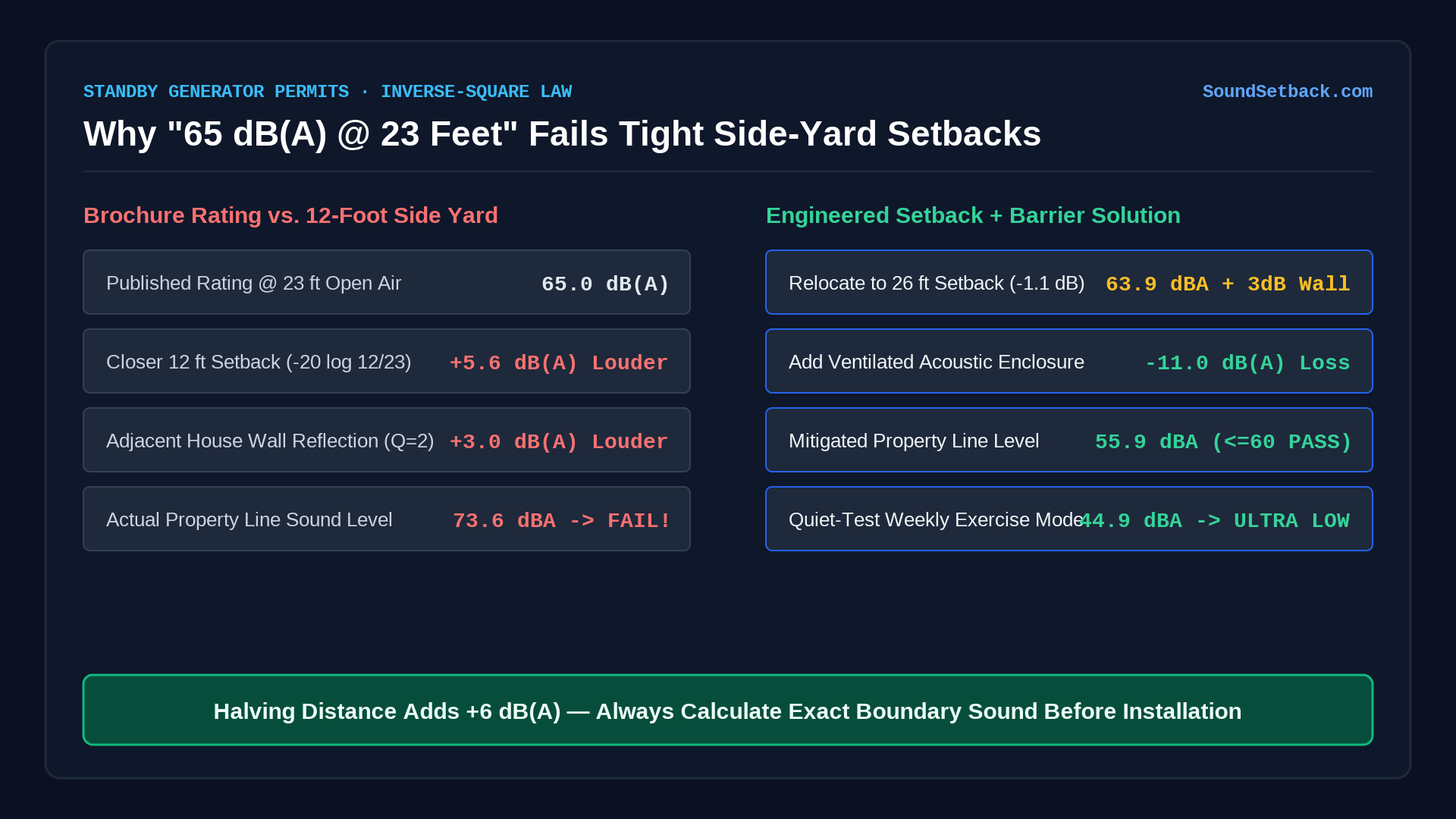
Installing a home standby generator (such as a Generac Guardian 22kW/24kW or Rehlko [formerly Kohler] 20RCA) requires more than an electrical and gas permit. Across suburban municipalities and Homeowners Associations (HOAs) in Texas, Florida, California, the Carolinas, Northeast, and Ontario, applicants must prove that operating sound pressure will not exceed 55 dB(A) or 60 dB(A) at the nearest adjacent property line.
1. The “23 Feet” Trap on Generator Brochures
Manufacturer spec sheets publish residential generator sound levels at a standardized distance of 23 feet (7 meters) in open free-field air — typically 62 to 67 dB(A) under load. Two real-world factors immediately change that number on a suburban lot:
- Closer Side-Yard Setbacks: By the inverse-square law (
ΔdB = -20 · log10(d2 / d1)), placing a 65 dBA (@ 23 ft) generator just 10 feet from a side fence increases boundary noise by +7.2 dB to 72.2 dB(A)! - House Wall Acoustic Reflection (+3 dB): Mounting the generator 18–36 inches off a hard exterior house wall reflects acoustic energy outward toward your neighbor (Directivity Factor
Q=2), adding roughly +3 dB(A).
See instant PASS / FAIL decibels at your boundary + download the 4-page HOA & Municipal Permit PDF with radial SVG map.
2. How to Pass Inspection on Tight Lots Without Moving the Pad
When relocating the generator to the middle of the backyard would cost thousands in extra gas piping and copper wire trenching, installing a gapless line-of-sight STC-28 outdoor acoustic barrier or engineered ventilated sound enclosure achieves 9 to 11 dB(A) of insertion loss — turning a 63.9 dBA rejection into a 52.9 dBA approval.